

A premium D2C ecommerce website for brands, with the admin to run it
Aurelia is a storefront and commerce admin for Indian lifestyle brands: editorial collections, variant-level stock, UPI and cash-on-delivery checkout, order tracking and tax invoices, designed around your brand rather than a theme.
- Editorial storefront, not a theme
- UPI, cards, netbanking and COD
- Tax invoices with HSN, IGST or CGST + SGST
Inside Aurelia
Screens from the live demo, on its sample data. Open the demo to try each one yourself.
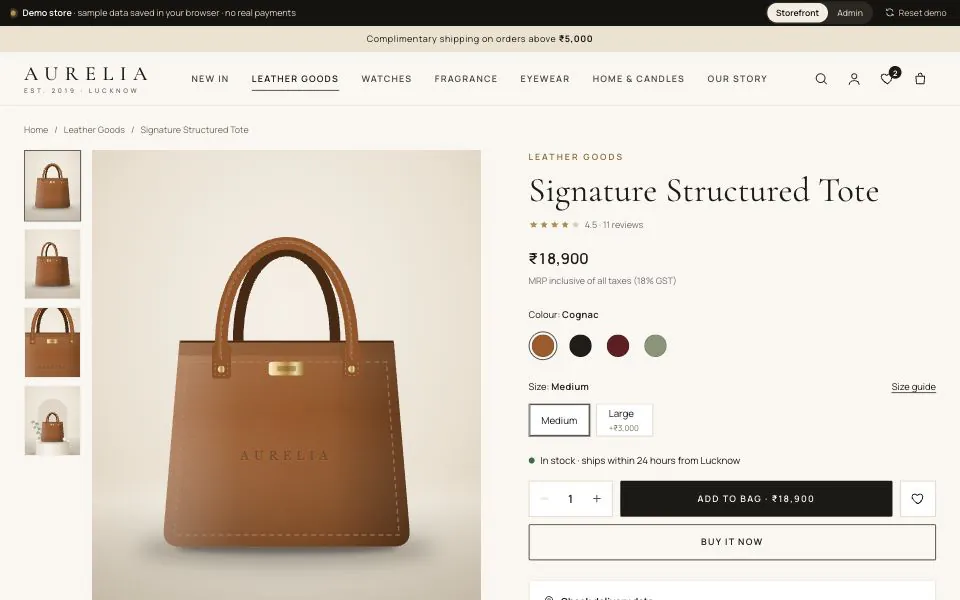
A product page: four-view gallery, colour and size variants with live stock, and a GST-inclusive price. 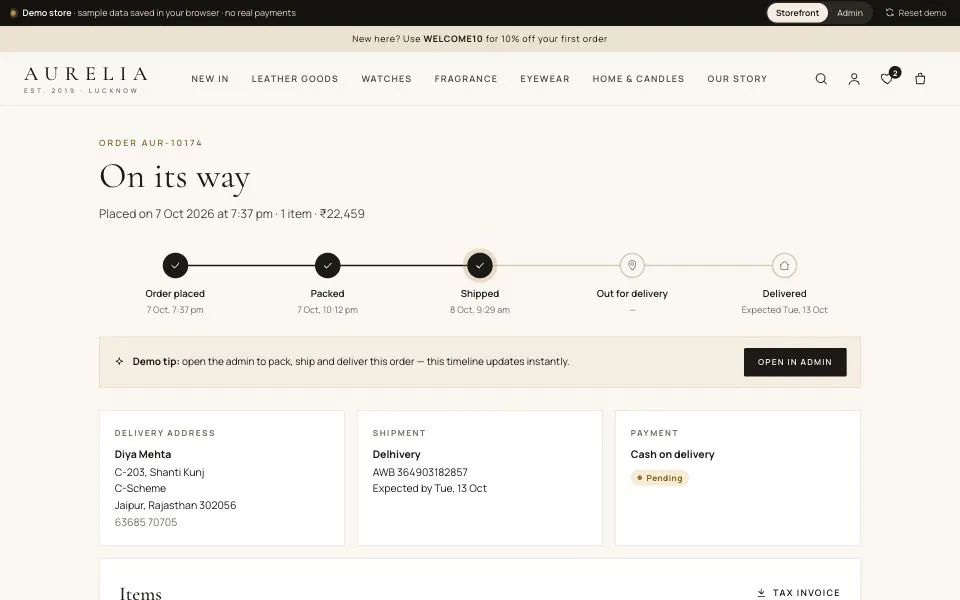
Customer tracking: the timeline, courier and AWB update as the team moves the order in the admin. 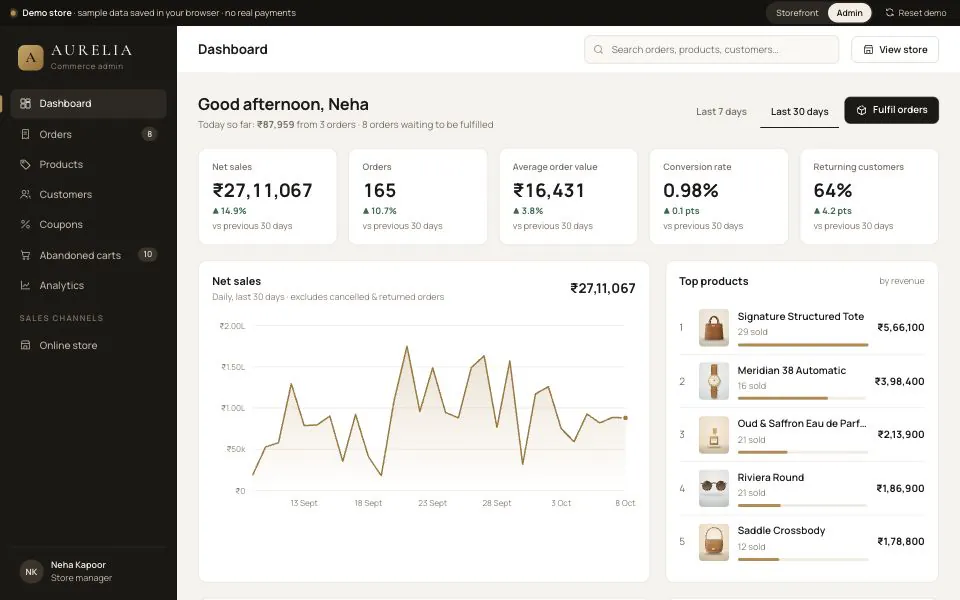
The admin dashboard: sales, conversion and best-sellers, with orders waiting to be fulfilled.
Premium ecommerce website design, built for how India pays
A D2C ecommerce website for brands that sell on craft has two jobs that pull against each other. It has to look like the brand, with the photography and pace of a printed lookbook. And it has to clear Indian checkout without friction: UPI, cash on delivery, pincodes a courier may not serve, and a GST invoice for the client ordering thirty gifts. Template themes usually manage the second and lose the first; marketplaces lose both.
Aurelia is our answer, built as a complete demo for a fictional leather, fragrance and home brand. The storefront has filtered collections, four-view product galleries, colour and size variants with live stock, and reviews. Checkout is one page, with saved addresses, delivery dates by pincode, express shipping, coupons, gift wrap and four ways to pay. Behind it, one admin holds orders, products, customers, coupons, abandoned carts and analytics.
It is not a Shopify theme or a plugin stack. It is custom code that we adapt and deploy for one brand at a time, on your domain, with your photography in place of the demo's illustrated products. That matters when your product page should follow your catalogue rather than a theme, or when a checkout rule is awkward on a hosted platform, such as COD only on certain pincodes and below a set order value.
Uttar Pradesh is full of the labels Aurelia was designed around: Kanpur leather, Kannauj attar, Lucknow chikankari, Moradabad brass, Bhadohi rugs. Many sell through marketplaces and Instagram messages today and want a store of their own. We are in Lucknow, so a D2C brand website for a Lucknow label gets its catalogue and design sessions in person; brands elsewhere in India work with us remotely, with visits around launch.
Who it is for
- Founder-led D2C brands moving off marketplaces
- Fashion, leather, jewellery and accessories labels
- Fragrance, attar, candle and home-décor brands
- Craft and heritage brands selling across India
- Brands taking corporate gifting orders that need GST billing
What Aurelia does
Editorial storefront and collections
Home, collection and brand-story pages laid out like a lookbook rather than a product grid. Collections filter by category, material, price and stock, with sorting, predictive search and a quick view that keeps shoppers in place.
Product pages with variant-level stock
A four-view gallery per colourway, colour and size options with their own stock, low-stock prompts, size guides, verified-buyer reviews and 'complete the look'. Sold-out options take a back-in-stock request instead of ending in a dead end.
Pincode delivery dates and COD rules
A pincode check on the product page shows the delivery date, whether express is available and whether cash on delivery is offered there. COD can be limited by pincode and order value, with a handling fee if you want one.
One-page checkout with UPI and COD
Saved addresses, city and state filled in from the pincode, standard or express shipping, coupons and gift wrap, all on one page. Customers pay by UPI, card, netbanking or cash on delivery; the demo simulates the gateway step.
Order tracking and GST invoices
Customers track with an order number and their phone or email, from placed to delivered, with courier and AWB. Every order has a printable tax invoice with HSN codes and CGST and SGST, or IGST, by place of supply.
Orders and fulfilment admin
Orders reach the admin the moment they are placed. Filter by status, payment or date, mark them packed or shipped in bulk, add courier and AWB, cancel, or process a return and refund; the tracking page updates as you go.
Products, variants and inventory
Products with colourways, sizes, size-based prices, stock per variant, HSN code and GST rate, saved as draft or live, with a storefront preview as you edit. Low-stock variants surface on the dashboard with a restock button.
Customers, coupons, carts and analytics
Customers by lifetime value and segment; percentage, flat and free-shipping coupons; abandoned carts with an email or WhatsApp reminder you preview before sending; and analytics for conversion, traffic sources and top cities, on sample traffic in the demo.
The demo runs on sample data in your browser and takes no real payments: place an order, ship it from the admin and watch the tracking page change. A deployed store runs on a server with real customer accounts, staff logins, a live payment gateway and backups.
Product images in the demo are illustrations drawn in code; your store uses your own photography.
What changes in your business
- A storefront that reads as your brand, not as a shared theme
- Fewer COD orders sent where you would rather not risk them
- Customers checking their own tracking instead of messaging you
- An invoice with every order, bulk gifting included
- Stock that is right per colour and size, with warnings before a sell-out
- Orders, stock, customers and coupons in one admin, not four tools
- Abandoned carts followed up the same day
Built in and connected
- Razorpay / Cashfree / PayU
- UPI, cards, netbanking, COD
- Shiprocket / Delhivery
- WhatsApp Business API
- Transactional email
- Google Analytics 4
- Meta Pixel
- Tally export
- Next.js
- PostgreSQL
Payment, messaging and hardware integrations are connected during setup, to the providers you already use where possible.
How we set up Aurelia for you
- 01
Brand and catalogue session
We go through your collections, variants, sizes and product language, plus shipping zones, COD rules and returns. For a Lucknow brand this happens at your studio; elsewhere, on a video call.
- 02
Design in your identity
Your logo, type, colours, photography and tone replace Aurelia's, and the layouts are signed off on your real products before building starts.
- 03
Catalogue and integrations
Products come in from your spreadsheet or an existing store's export. Payment gateway, courier and messaging accounts are connected and tested end to end in each provider's test mode.
- 04
Soft launch and handover
The store opens to a small audience first, so payments, packing, pickups and invoices run on real orders before ad spend goes behind it. Your team is trained on the admin, and support terms are agreed before go-live.
What we need from you
- Product catalogue in Excel or CSV, with variants, sizes, prices and HSN codes
- Product photography, or a plan and budget for a shoot
- Logo, typefaces, colours and a sense of your brand voice
- Payment gateway and courier accounts, or a decision on which to open
- GSTIN, your shipping, COD and returns policies, and access to your domain
None of it has to be tidy. Discovering that your data is messier than expected is part of the job, not a reason to delay starting.
Aurelia — questions buyers ask
Including what it costs, what it does not do, and who should buy something else.
Why not just use Shopify?
Often you should. If your catalogue is simple, you want to launch this month and your team is happy in Shopify's admin and apps, a good theme there is quicker and cheaper than a custom build. A D2C ecommerce website for brands like Aurelia makes sense when design is part of what you sell, when your COD or gifting rules fight the apps, or when you want a custom ecommerce platform you control rather than rent.
What does a store like this cost?
It depends on how far the design moves from Aurelia, the size of your catalogue, which integrations you need (gateway, courier, WhatsApp, accounting), and whether you want help with photography or copy. Gateway, courier and hosting charges are paid to those providers. We quote after a short call and a look at your catalogue, not before.
Will it work on mobile, or do we need an app?
The storefront is designed for phones first: a sticky add-to-bag bar, a one-page checkout and UPI that opens the customer's payment app. Most D2C brands do not need an app at launch, because nobody has to install anything to buy. If repeat customers later justify one, we build it on the same backend.
Can you import our existing catalogue?
Yes. Products usually arrive as an Excel or CSV sheet, or an export from Shopify, WooCommerce or a marketplace seller panel. We map them to colourways, sizes, stock per variant, HSN code and GST rate, and flag missing sizes or images before import. Past customers and orders can come across too, so lifetime value starts from real history.
Does it produce GST invoices?
Yes. Every order gets a tax invoice with your GSTIN, HSN codes and the rate per item, split into CGST and SGST for buyers in your state or IGST for buyers outside it. Rates are set per product on your CA's advice rather than assumed. If you also sell to registered businesses and cross the notified e-invoicing threshold, e-invoice generation can be added.
How much of the design can we change?
All of what customers see: your logo, type, colours, layouts, photography and copy replace Aurelia's. Luxury ecommerce website development in India often starts from a theme and bends it. We start from flows that already work, such as variants, pincode checks, checkout, tracking and invoices, and redesign everything around them. Features like monogramming or a wholesale login can be added.
Do you work with brands outside Lucknow?
Yes. Our office is in Lucknow, so brands here and in nearby UP cities get catalogue sessions, design reviews and launch support in person. Brands elsewhere in India work with us over video calls, with a visit for the catalogue session or launch when it helps. Support after launch is remote for everyone, because that is where the store lives.
Who is Aurelia not right for?
If you sell hundreds of low-priced SKUs, compete mainly on discounts or need to be live within a fortnight, a hosted platform will serve you better. The same goes if most sales come from marketplaces and you only want a brochure site, or if you need a multi-vendor marketplace. Aurelia suits brands whose margins depend on looking premium.
Other live demos
When you need it built differently
The product is a starting point. These are the services behind it, for when the requirement goes further.
Want to see your range in Aurelia?
Send us a few products and your brand guidelines. We will take you through the demo on a call, show where your catalogue fits and what would change, and quote for the build.